



Direct answer: Choose 2700K when you want the softest evening mood, especially behind amber or brown glass. Choose 3000K when you want a cleaner warm light that keeps beige-white or green glass and nearby wall colors easier to read. Neither is universally better: the exact glass batch, bulb output, dimmer level and bedroom finishes decide the final appearance.
Kelvin Describes Appearance, Not Brightness
Color temperature describes whether white light appears warmer or cooler. Lumens describe output. A 2700K and a 3000K bulb can have the same lumen rating and still make the room feel different, so compare Kelvin and lumens as separate decisions. ENERGY STAR's LED lighting overview explains the labeling and efficiency features useful when comparing packages.
2700K tends toward a warmer, more amber appearance associated with traditional incandescent light. 3000K is still warm white, but it usually shows less amber and can feel crisper beside white bedding, painted walls or artwork. The 300K difference is visible in a side-by-side test, yet subtle enough that glass color and brightness can outweigh it.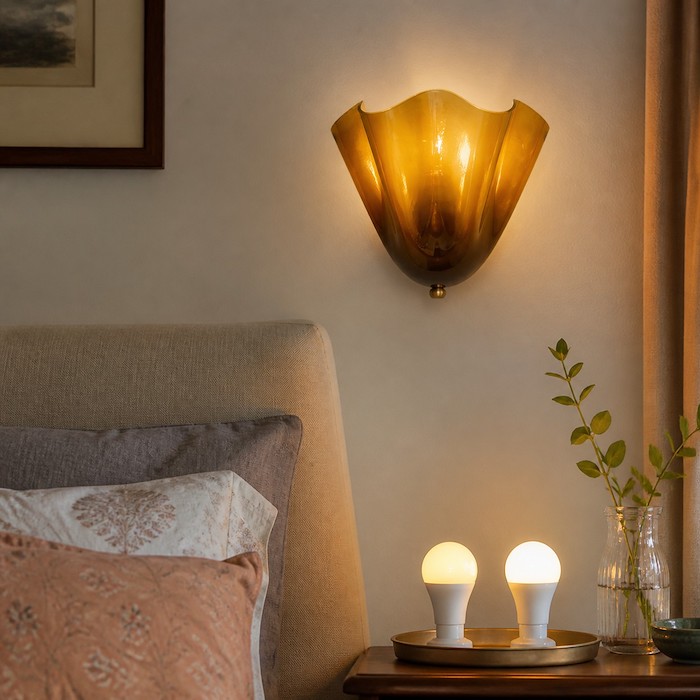
Colored Glass Acts Like Part of the Light Recipe
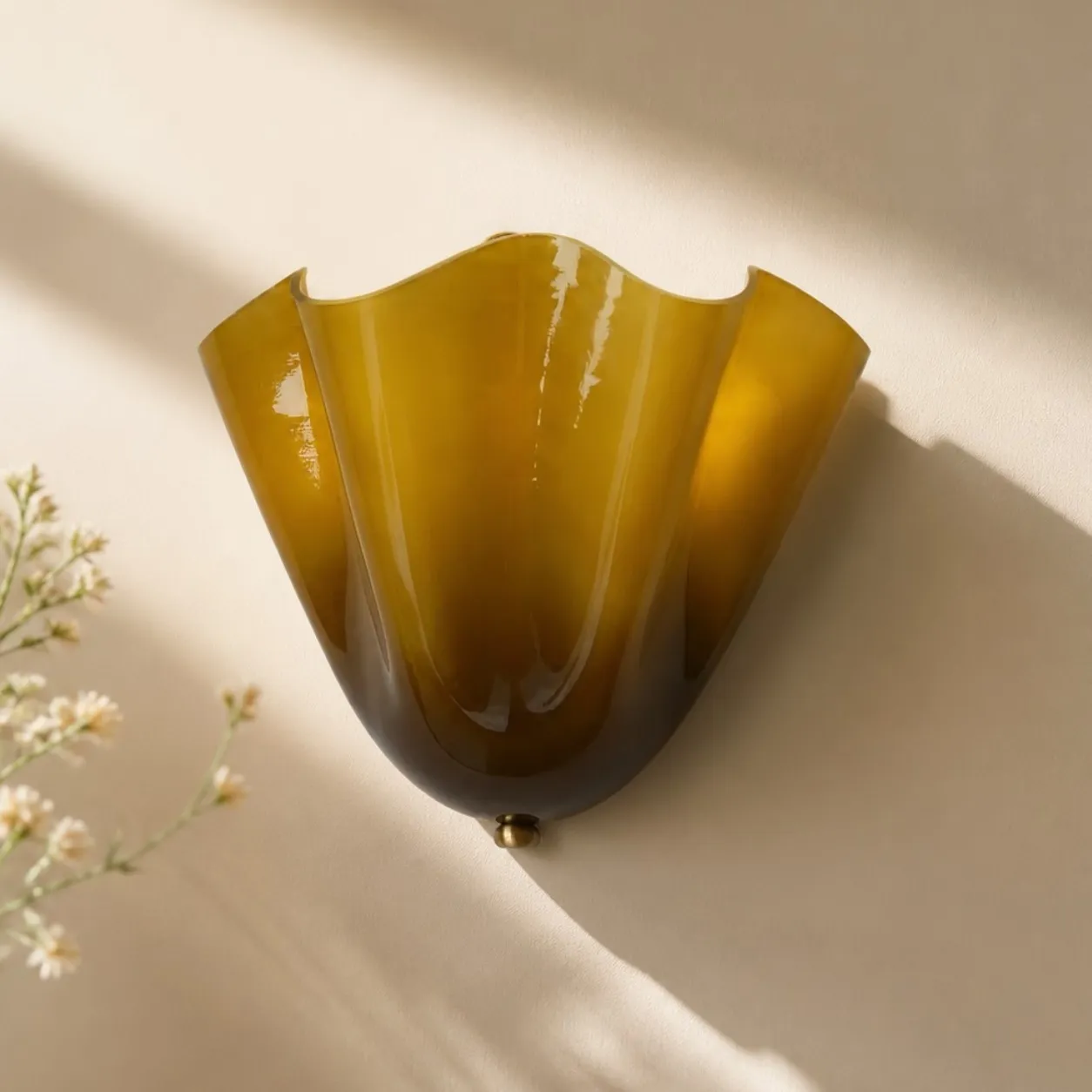
The Bellina Wall Lamp is offered in beige white, green, brown and amber on the current product page. Its hand-blown translucent glass does not simply reveal the bulb; it filters, reflects and redistributes the light. Two nominally identical shades can show small color and measurement differences, which the product page notes as inherent to the process.
Use these as starting observations:
- Amber glass: 2700K reinforces a rich golden mood; 3000K can keep the result from becoming overly orange.
- Brown glass: 2700K looks cocooning at low output; 3000K may preserve more distinction in nearby wood and textiles.
- Beige-white glass: both work, with 2700K softer and 3000K cleaner.
- Green glass: 3000K is a useful first sample when you want the green to read clearly; 2700K can make it feel more muted or olive.
These are editorial test points, not fixed color-science results for every bulb. Wall paint, daylight, camera white balance and LED spectral quality can all change the impression. The final decision should be made with the exact shade and bulb in the installed room.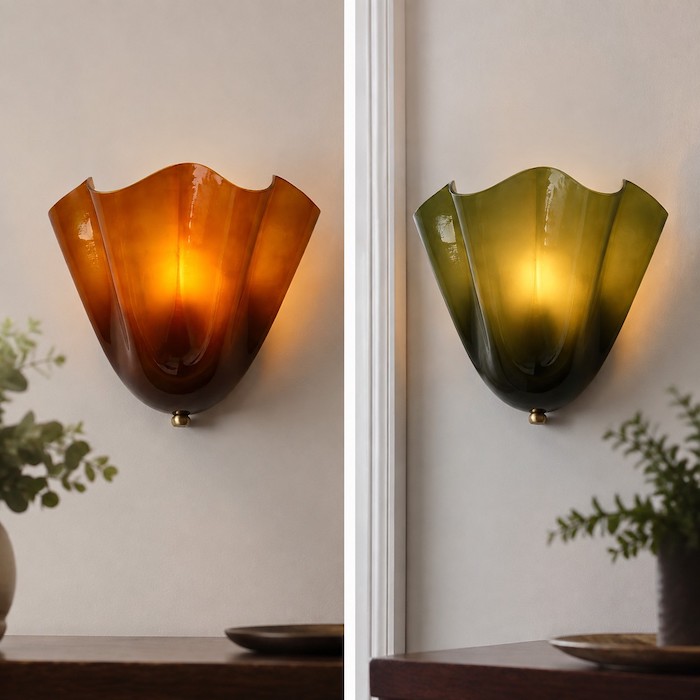
Match the Temperature to the Bedroom's Job
For a sconce used mainly after dinner, 2700K at a low dimmer setting often supports a quieter atmosphere. For dressing, reading or a bedroom that also serves as a workspace, 3000K can offer a clearer warm appearance. If task lighting matters, brightness distribution and glare control are at least as important as the Kelvin label.
Human sleep-wake timing is influenced by light and darkness. The National Institute of General Medical Sciences explains the role of environmental light in circadian rhythms. That does not make 2700K a medical prescription, but it is a practical reason to avoid running either bulb brighter than necessary late at night.
A 2022 PNAS study also reported physiological effects from moderate room light during sleep. Its setup is not the same as every bedroom sconce, so the responsible takeaway is modest: turn the light down or off for sleep rather than relying on a warmer Kelvin number alone. Review the study design and results.
Test Glass, Wall Color and Skin Together
Place one 2700K sample in one socket and one 3000K sample in the other only for a brief visual comparison, then use a matched pair for normal operation. View the lamp from the bed, doorway and mirror. Check whether skin looks natural, whether the wall shifts unexpectedly, and whether one bulb creates a more obvious bright point through the petals.
Turn off other lamps during the first comparison, then repeat with the room's normal lighting. A 3000K ceiling light can make a 2700K sconce appear extra amber, while afternoon daylight can make both look warmer by contrast. Evaluate after dark because that is when the sconce is likely to carry the room.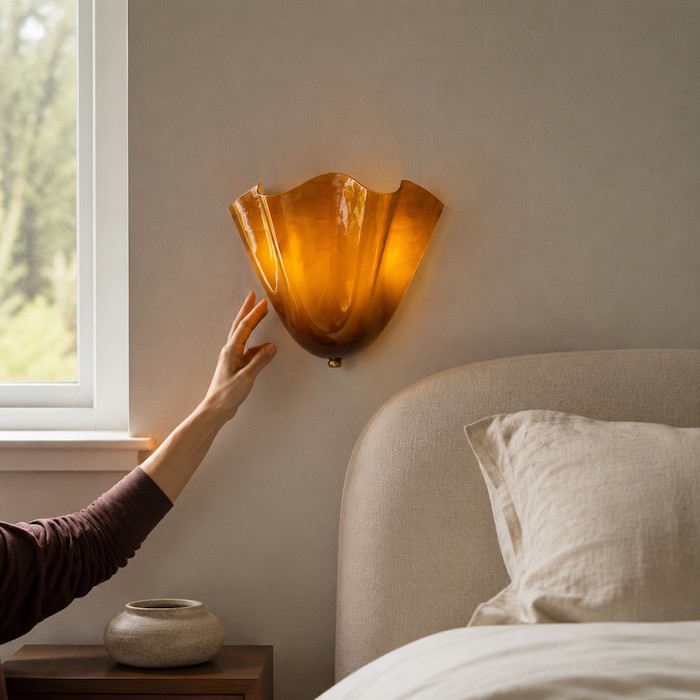
Do Not Let a Phone Screen Make the Decision
Phone cameras automatically alter white balance and exposure. A photographed 2700K scene may look nearly neutral, while an amber glass shade may appear more saturated than it does to the eye. Use photos to record placement, not to judge the final color temperature. If you must compare remotely, lock the same camera settings for both images and keep the same wall, dimmer level and exposure.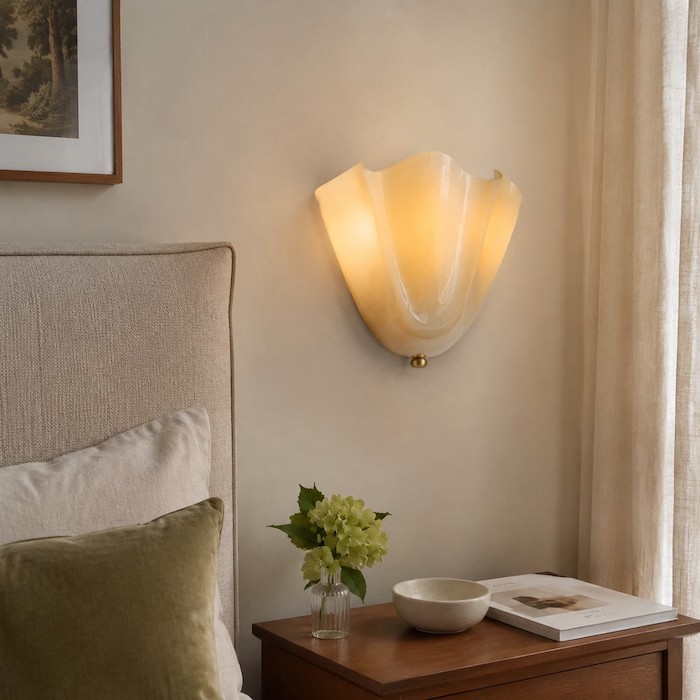
A Simple 2700K-versus-3000K Decision
- Choose two dimmable LED samples with the same shape, lumens and color-rendering rating.
- Check that both fit the E26/E27 socket and clear the glass.
- Compare at full task level and at the lowest stable dimmer level.
- View skin, wall paint, bedding and the glass itself from normal positions.
- Select one model and install a matched pair so color and dimming remain even.
For socket, lumen and glare checks, read How to Choose a Bulb for a Petal Glass Wall Sconce: E26/E27, Lumens, Kelvin and Glare. If the bulb envelope is visible or crowded, use What Bulb Shape Fits a Glass Wall Sconce: A15, A19 or Decorative LED?. When the color choice is settled, protect the shade with How to Clean a Hand-Blown Glass Sconce Without Scratching or Loosening the Shade.
See Bellina's current colored-glass options before buying a bulb sample, because an online swatch cannot reproduce the lit shade.
Explore the Bellina Wall Lamp
FAQ
Is 3000K too cool for a bedroom?
Usually not; 3000K is still considered warm white. Keep output controlled and test it against the actual glass and wall color.
Does amber glass make 2700K look more yellow?
It can deepen the warm appearance, which is why a one-bulb comparison with 3000K is useful.
Can I use one 2700K and one 3000K bulb together?
Use that pairing only for a brief comparison. A matched pair normally gives a cleaner, more even result.
Will a dimmer change Kelvin?
Many standard LEDs become dimmer without becoming much warmer. Only bulbs designed for warm-dim behavior intentionally shift color as they dim.
Which is better for reading?
Either can work. Adequate controlled lumens, low glare and good color rendering matter more than the 300K difference alone.