



The Ultimate Wall Lamp Height Guide: How to Position Sconces in Every Room
You have just finished painting the walls, the furniture is perfectly arranged, and you are ready to add the final, crucial layer of design: the lighting. Wall sconces and wall lamps are incredibly powerful tools in interior design. They instantly elevate the mood of a room, add layers of ambient illumination, and serve as striking architectural features on otherwise blank walls.
However, when it comes to installing them, many homeowners and even novice decorators freeze at a critical question: What height should you choose for your wall lamp?
Get it right, and your room feels professionally curated, bathed in a warm, flattering glow. Get it wrong, and you might find yourself staring directly into a blinding lightbulb every time you walk down the hall, or dealing with fixtures that look awkwardly disproportionate, floating too high like airport runway lights or sitting too low and obstructing your furniture.
Choosing the appropriate height for your wall sconce is not just about picking a random number; it is a delicate balance of human ergonomics, spatial proportions, and the specific function of the room. In this comprehensive guide, we will walk you through the universal rules of wall lamp placement, explore how different spaces require distinct approaches, and reveal the hidden factors—like lampshade materials—that completely change the game.
The Universal Golden Rule: The 60-66 Inch Benchmark
If you are looking for a quick, industry-standard answer, here is the golden rule of thumb used by electricians and interior designers worldwide: You should mount your wall sconces so that the center of the fixture is between 60 and 66 inches (approximately 150 to 168 cm) from the floor.
Why this specific range? The philosophy behind this measurement is entirely centered on human ergonomics. Sixty to sixty-six inches represents the average eye level for an adult standing up. By placing the center of the light source directly at or slightly above eye level, you achieve two critical things:
- Glare Prevention: You ensure that the brightest part of the bulb is hidden from your direct line of sight when you are walking through the room.
- Aesthetic Balance: This height visually cuts the wall at a pleasing, natural level, bridging the gap between your furniture and your ceiling without leaving too much negative space on either end.
A Pro Measurement Tip: When instructing your electrician on where to place the wiring, ensure they understand that the 60-66 inch measurement is from the floor to the junction box (the center of the light), not the very top or the very bottom of the decorative fixture itself.
Advanced Rule: Why Lamp Materials Alter the Height Rule
While the 60-66 inch rule is an excellent starting point, most generic lighting guides fail to mention a crucial variable: the material and design of your chosen wall lamp. The material of the lampshade dictates how the light is dispersed, which in turn dictates how strictly you need to adhere to the "eye-level" rule.
If you purchase a wall lamp with a fully transparent clear glass globe or an exposed Edison bulb, your margin for error is virtually zero. Because the light source is completely bare, if you mount it even slightly too low, it will cause harsh, uncomfortable glare every time you glance in its direction.
Conversely, wall sconces equipped with diffusers—specifically fabric shades—are incredibly forgiving. A fabric shade acts as a natural filter, softening the harshness of the bulb and transforming it into a warm, ambient wash of light.
Because fabric shades eliminate the risk of direct glare, they offer you much more flexibility in your mounting height. If you need to mount the fixture slightly lower to align with a specific piece of art, or slightly higher due to architectural constraints, a fabric-shaded lamp will not punish your eyes.
Beyond comfort, these fixtures also serve an aesthetic function. Are your low ceilings feeling cramped? You can solve the space pain point with the vertical elongation illusion of wood fabric sconces. The slender, vertical lines of a wooden bracket naturally draw the eye upward, while the soft, ambient wash of light from the fabric shade blurs the hard boundary between the wall and the ceiling. This creates a visual "lift" that makes the room feel significantly more spacious and airy, turning a structural limitation into a clever design feature.
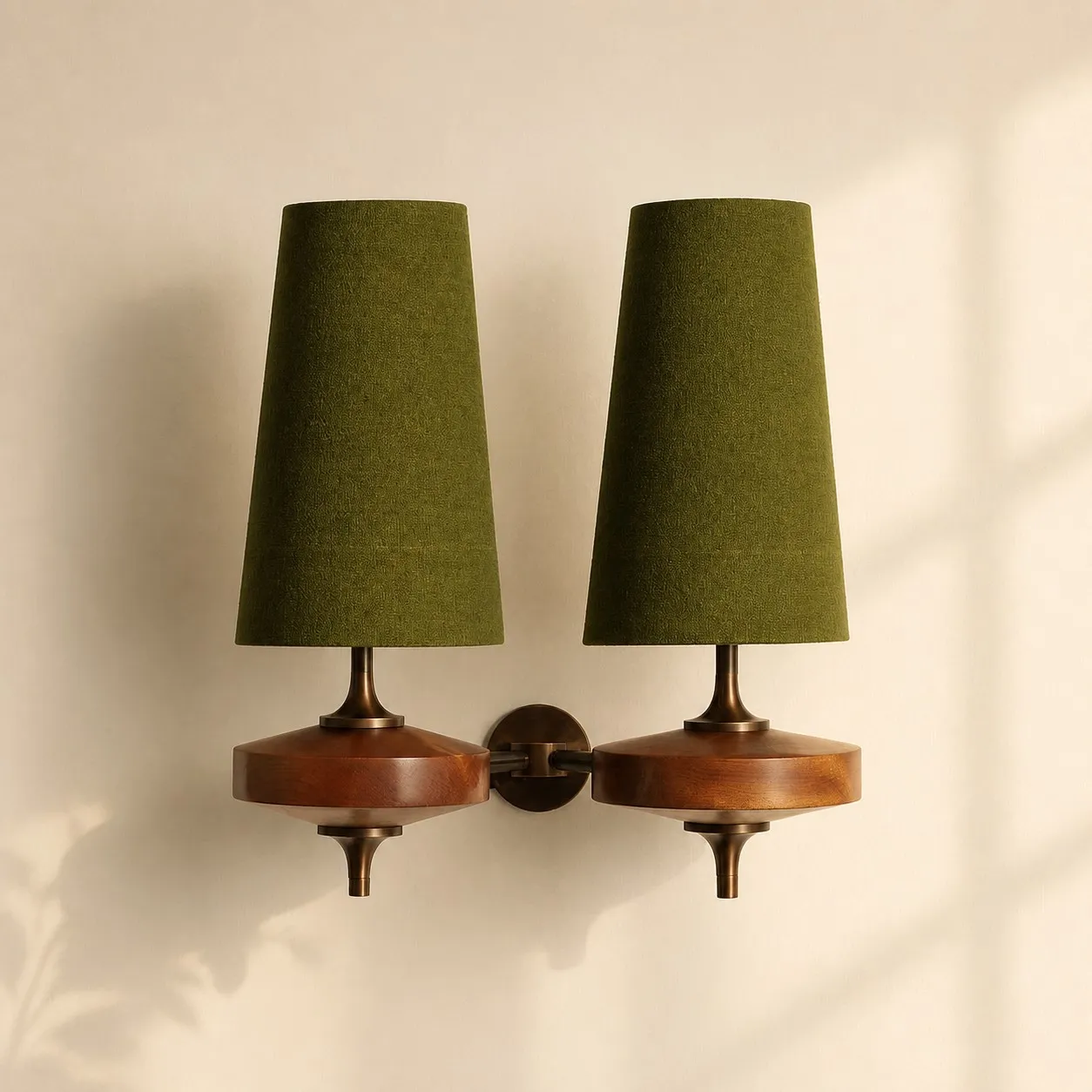
This brings us to a perfect example of a highly versatile, glare-free fixture. The Hour Rho Wall Lamp - Modern Wood Wall Sconce with Fabric Shade for Hallway and Living Room is designed specifically with this soft-lighting philosophy in mind. Featuring a beautifully crafted wooden base paired with a premium fabric shade, it ensures that whether you mount it strictly at 60 inches or slightly adjust it to fit your space, the light output remains gentle, inviting, and entirely free of harsh glare. It is the ultimate "forgiving" fixture for those who want foolproof elegance.
Appropriate Heights for Different Spaces
While the golden rule applies generally to open walls, every room in your house serves a different purpose, features different furniture, and requires a tailored approach. Here is your room-by-room guide to perfect sconce placement.
1. The Living Room: Flanking the Sofa or Fireplace
In the living room, your wall lamps are usually interacting with significant pieces of furniture, such as a large sectional sofa, a console table, or a central fireplace. Here, you must use a "reference point" measuring method rather than just measuring from the floor.
If you are mounting wall sconces on the wall directly behind your sofa, the standard 60-inch rule might result in the lamps sitting too close to the top of the sofa, making the space feel cramped. Instead, measure from the highest point of the sofa's backrest. The bottom edge of the wall lamp should sit at least 6 to 8 inches above the top of the sofa. This prevents anyone from bumping their head against the fixture when they stand up or lean back, while still keeping the light low enough to provide a cozy reading atmosphere.
For living spaces, the Hour Rho Wall Lamp serves as an exquisite visual anchor. When placed on either side of a sofa or flanking a piece of wall art, its modern Nordic wood aesthetic brings a touch of organic warmth to the living room, while the fabric shade provides the exact type of soft, layered ambient lighting necessary for relaxing evenings.
2. The Hallway and Walkway: Creating Flow Without Glare
Hallways are often the darkest areas of a home, completely devoid of natural light. Wall sconces are the perfect solution to break up the "tunnel effect" of a long corridor.
In a hallway, you are exclusively walking, not sitting. Therefore, you should adhere strictly to the 60 to 66-inch floor-to-center rule. Mounting them any lower creates a physical obstacle that people might brush their shoulders against. Mounting them any higher can make your interior hallway feel like an outdoor alleyway lit by streetlamps.
Spacing is just as important as height here. To create a natural rhythm, space your hallway sconces 8 to 10 feet apart along the wall. If you are looking to upgrade your corridors, you can explore our complete wall sconce collection for inspiration.
Because hallways are narrow, you frequently view the fixtures from a side angle. This makes the Hour Rho Wall Lamp an ideal candidate. It has a sleek, unintrusive profile that does not protrude excessively into the walkway space. Furthermore, its fabric shade gently directs light up and down the wall, safely guiding your path without shining directly into your eyes as you walk past.
3. The Bedroom: Sconces as Bedside Reading Lights
When moving into the bedroom, it is time to throw the standard standing "eye-level" rule completely out the window. If you are installing wall lamps on either side of your bed to serve as reading lights, your reference point is now based on a seated or lying position.
If you place a bedside sconce at 60 inches high, the light will cast shadows over your book and feel completely disconnected from the bed. Instead, measure 30 to 36 inches upward from the top of your mattress.
Alternatively, for a bespoke fit, sit comfortably in your bed leaning against the headboard in your normal reading posture. Have a partner mark the wall just above your shoulder height. This is the exact spot where the center of the sconce should go. This ensures the light shines perfectly over your shoulder and onto your page. For more tips on creating a restful sanctuary,dive into our comprehensive guide on bedside reading light placement.
4. The Bathroom: Flanking the Vanity Mirror
Bathroom sconce placement is arguably the most critical in the house because it directly affects how you see yourself every morning. Overhead recessed lighting creates terrible, unflattering shadows under your eyes, nose, and chin. Wall lamps placed on either side of the vanity mirror are the ultimate solution for flawless grooming and makeup application.
To eliminate facial shadows entirely, the light source must be exactly at your face level. Mount bathroom sconces between 60 and 65 inches from the floor, positioning them on the left and right sides of the mirror. Ideally, they should be spaced about 36 to 40 inches apart from one another to ensure the light evenly crosses your face from both directions.
Safety Note: Because bathrooms are humid environments, always verify your local building codes and ensure you are choosing IP-rated bathroom lighting fixtures that are certified to withstand moisture and dampness safely.
Pro Tips for High Ceilings: The Proportion Rule
Before you finalize your measurements, you must take your ceiling height into account. The traditional 60-66 inch rule was developed during an era when the standard home ceiling height was 8 feet. If you live in a modern build with 9-foot, 10-foot, or vaulted ceilings, a sconce placed at 60 inches might look awkwardly low, almost as if it is sinking toward the floor.
Designers use a simple scaling formula to fix this: For every foot of ceiling height above 8 feet, raise the height of your wall sconce by 2 to 3 inches.
- For an 8-foot ceiling: Stick to 60-66 inches.
- For a 9-foot ceiling: Adjust to 63-69 inches.
- For a 10-foot ceiling: Adjust to 66-72 inches.
However, there is an upper limit to this architectural adjustment. As a general visual boundary, try not to mount your sconces higher than the top frame of your interior doors or windows. Aligning the height of your lighting with the horizontal lines of your door frames helps maintain a sense of structural harmony throughout the space.
Conclusion: Test Before You Drill
Finding the perfect height for your wall lamp is an art that blends the mathematical rules of proportion with the practical realities of your daily life. Whether you are illuminating a long hallway to create a welcoming flow, or setting up a cozy reading nook in your living room, the height of your fixture dictates the overall ambiance.
Before you commit and have your electrician cut holes in the drywall, we highly recommend the "cardboard test." Cut a piece of cardboard to the approximate size of your chosen lamp and use painter's tape to stick it to the wall at your calculated height. Step back, sit on your sofa, walk past it, and see how it feels in the space.
By considering your room's function, your furniture layout, and taking advantage of glare-reducing designs, you can create a brilliantly illuminated home that feels both comfortable and impeccably designed.
Frequently Asked Questions (FAQ)
Can I mount a wall sconce higher than 66 inches?
Yes, if your home has ceilings higher than the standard 8 feet, you should adjust the height. A good rule of thumb is to add 2 to 3 inches to the sconce height for every additional foot of ceiling height, ensuring the proportions look balanced.
Does the height rule change if my wall lamp has a clear glass shade?
Absolutely. Clear glass shades or bare Edison bulbs have no light diffusion and can cause severe glare. You must strictly adhere to placing them at or slightly below eye level (around 60 inches) so the bulb does not shine directly into your eyes when standing or walking by.
How far above my nightstand should a bedroom wall lamp be?
For bedroom reading lights, do not measure from the floor. Sit in bed in your normal reading position and mark your shoulder height on the wall. Typically, this translates to mounting the center of the sconce 30 to 36 inches above the top of your mattress.