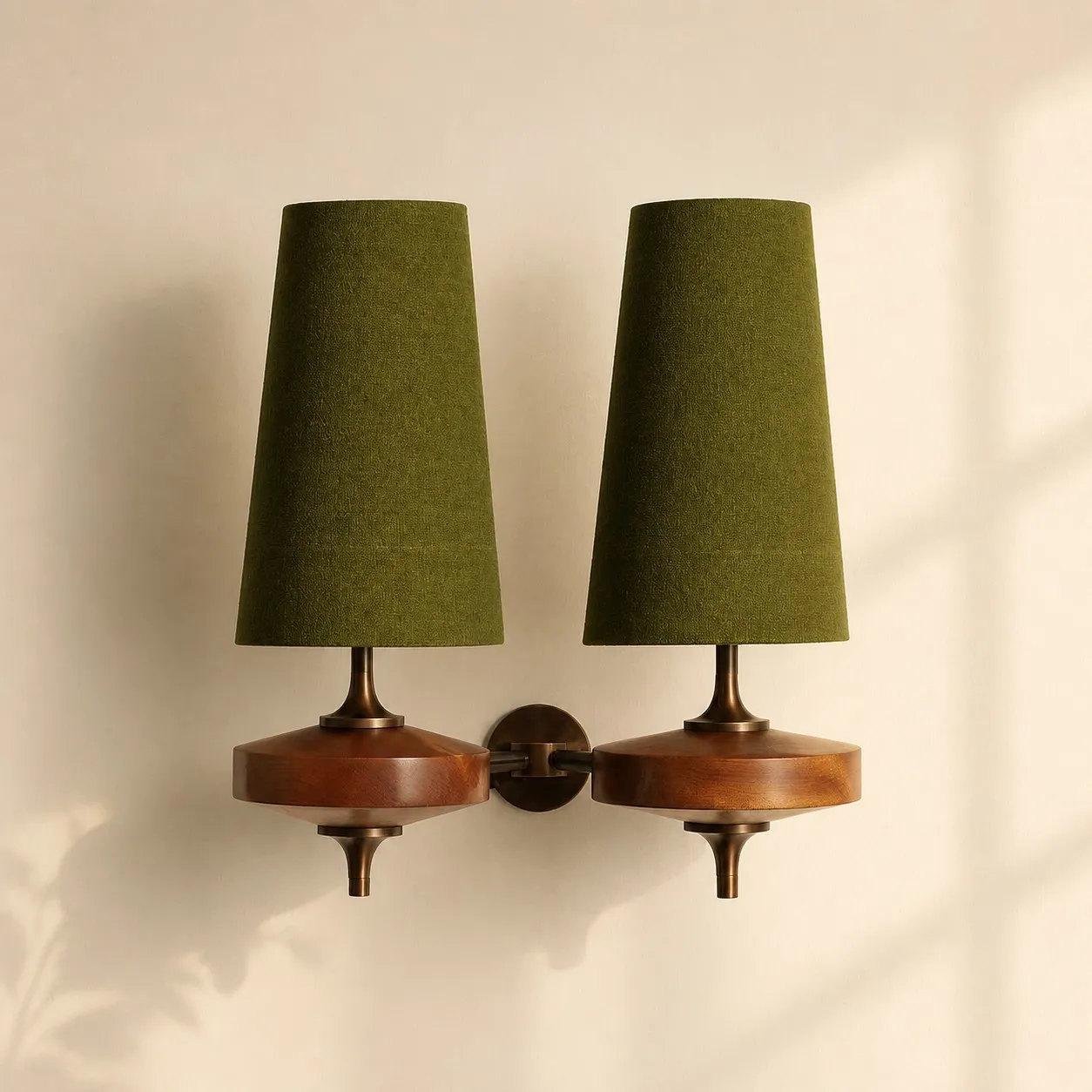




One-Light or Two-Light Wall Sconce? Choose by Wall Width, Not Habit
In a one light vs two light wall sconce decision, choose the version whose complete outline fits the wall composition. A one-head fixture leaves more negative space on narrow wall piers and repeated hallway runs. A two-head fixture carries more visual weight on broad walls. Two sockets do not guarantee twice the useful brightness, because lamp lumens, shades and light distribution still matter.
Define the Comparison Correctly
This article compares one individual one-head wall sconce with one individual two-head wall sconce. It is not comparing a single fixture with a pair of fixtures. That distinction matters: adding a second head changes the width, symmetry and number of light sources while keeping one mounting location.
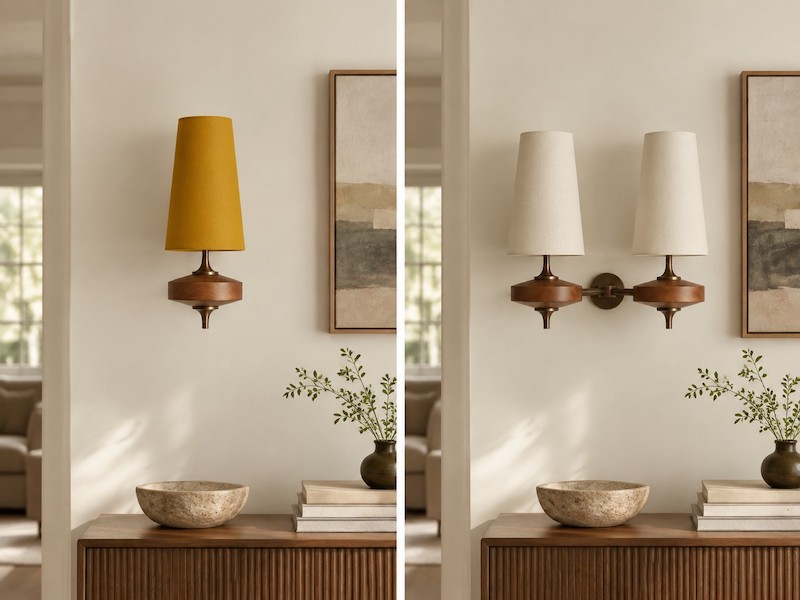
The current Hour Rho product page lists both variants at approximately 35 cm (13.8 in) high. The one-head version is about 19 cm (7.5 in) wide; the two-head version is about 35 cm (13.8 in) wide. Both are described as wood, metal and fabric, hardwired, E26 and UL Listed. Confirm the live specification for the chosen variant before purchase or electrical work.
For the complete placement sequence around either option, start with Wall Sconce Placement Guide: Height, Spacing & Scale.
The Main Difference Is Visual Width
A one-head sconce reads as a vertical accent. It can fit between door casing and a corner, beside a narrow picture or in a repeated run where each fixture needs breathing room. The two-head version reads more like a compact horizontal composition. It can balance a wider console, larger art or an empty section of wall without adding another backplate.
Calculate side clearance, not just wall width. If a wall pier is 24 in wide, a 7.5 in fixture leaves about 8.25 in on each side when centered. A 13.8 in fixture leaves about 5.1 in. Both technically fit, but the second will feel much fuller. Tape the outlines because trim, shadows and shade volume alter the perception.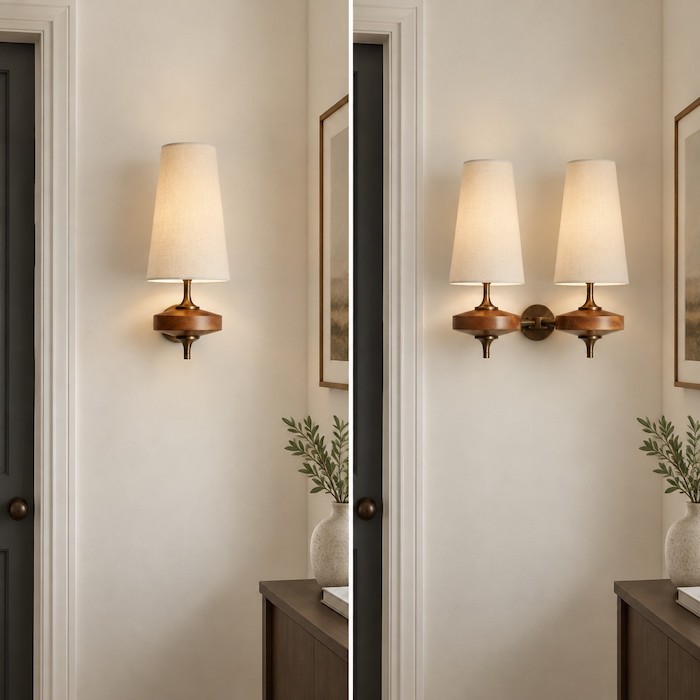
Hour Rho provides a direct way to compare these two widths within one design family.
Compare the One-Head and Two-Head Hour RhoOne-Head: Best When the Wall Needs Breathing Room
Choose the one-head version when the fixture must occupy a narrow wall segment, when several sconces repeat down a hall, or when artwork is already the dominant object. Its narrower width preserves negative space and usually creates a lighter rhythm.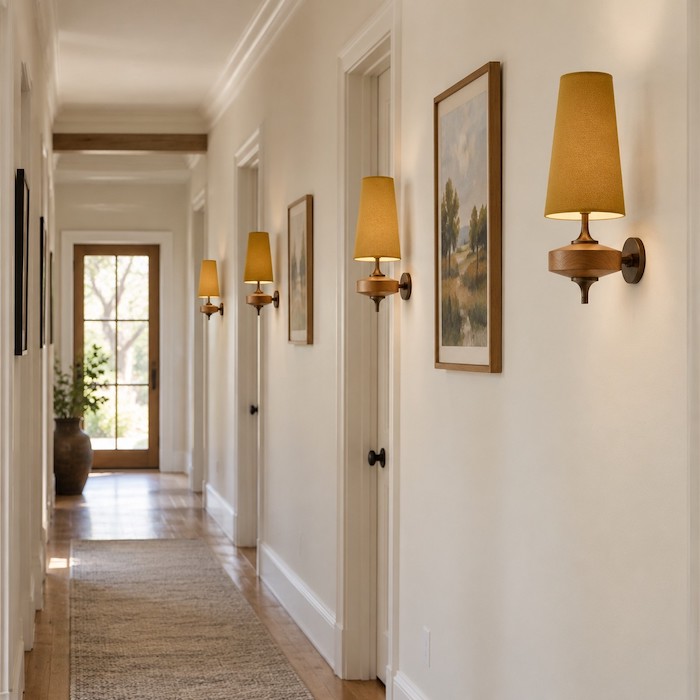
It is also easier to center visually on a slim architectural bay. That does not mean it should be placed higher or closer together by default. Use the same height and spacing tests as any other fixture, then judge its outline.
If several one-head fixtures form a run, calculate their positions with How Far Apart Should Wall Sconces Be in a Hallway? and check the edge gaps after the centers are fixed.
Two-Head: Best When One Mounting Point Needs More Presence
Choose the two-head version when a broad wall makes a narrow fixture look incidental, when a console and artwork need a wider anchor, or when a symmetrical shape supports the room's composition. It provides two light sources within one centered object and can reduce the visual emptiness around a small backplate.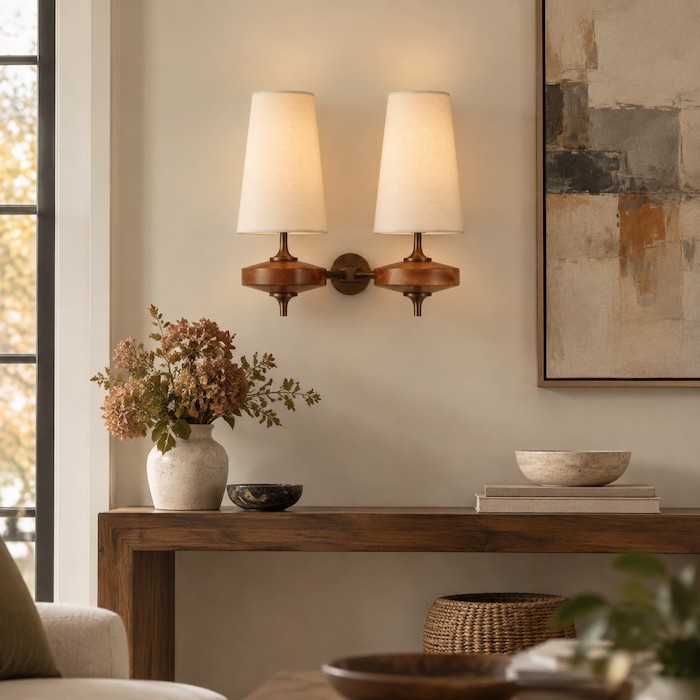
A two-head sconce is not automatically appropriate for every large room. On a busy gallery wall or beside wide trim, the extra width can compete with other elements. It may also reduce the visible gap in a repeated hallway run, making the sequence feel dense even when the centers have not moved.
Do Two Lights Mean Twice the Brightness?
No. Two sockets give you two potential light sources, but useful brightness depends on the lumen output of the compatible bulbs, the way the fabric shades transmit and direct light, wall color, fixture position and other light layers. The Federal Trade Commission's light-bulb guidance distinguishes lumens, which indicate brightness, from watts, which indicate energy use.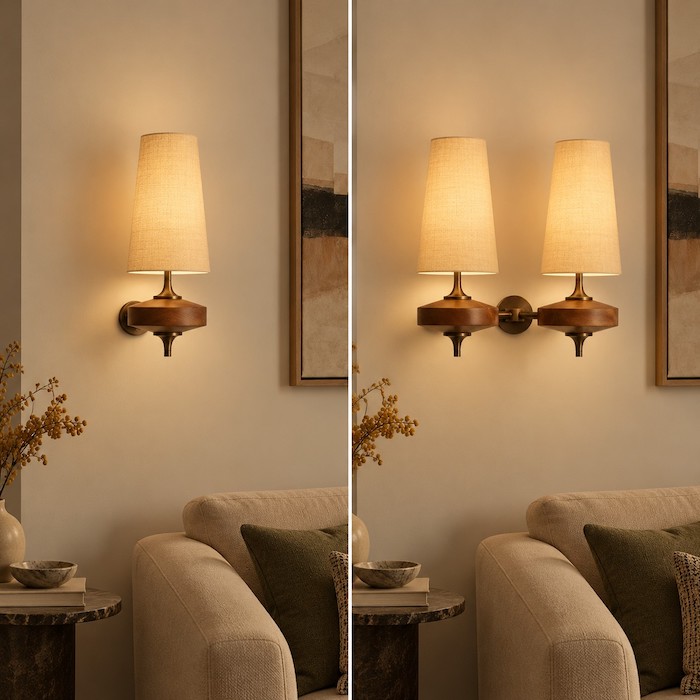
Compare the total verified lumens of the lamps you plan to use, while staying within the fixture manufacturer's current requirements. Then ask whether the light is ambient, decorative or expected to support a task. A two-head shaded fixture may broaden the glow, but it is not proof of a precise two-times increase at the floor, wall or reading surface.
Side-by-Side Decision Table
| Decision factor | One-head version | Two-head version |
|---|---|---|
| Current approximate size | 19 × 35 cm / 7.5 × 13.8 in | 35 × 35 cm / 13.8 × 13.8 in |
| Visual character | Narrow, vertical, lighter | Broader, balanced, more present |
| Strong use case | Narrow pier or repeated hallway rhythm | Broad wall or centered furniture composition |
| Spacing effect | Larger edge gap at the same centers | Smaller edge gap at the same centers |
| Brightness decision | Use verified bulb lumens and shade effect | Add the verified lumens; do not assume a two-times result |
Height Usually Does Not Change Just Because Width Does
Since both current Hour Rho variants share an approximate overall height, you can begin with one vertical paper band and swap the widths. Still mark the actual light-source centers because a two-head arrangement may place the bulbs differently around the central mount.
Use seated and standing views in living rooms, and moving views in hallways. How High Should Wall Sconces Be? A Room-by-Room Guide explains why the light-source, fixture and junction-box centers should not be treated as one point.
Four Real-World Choices
A narrow return wall
Start with one head. The priority is clean space beside trim and the corner, not maximum fixture width.
A long hallway with four mounting points
Start with one head and inspect the rhythm. Test two heads only if the wall still feels sparse and the edge gaps remain comfortable.
A wide console beneath medium artwork
Start with two heads as a centered anchor. Compare its width with the art and furniture, then confirm glare from nearby seating.
A wall already filled with art
Start with one head or simplify the composition. More fixture width may create visual competition rather than balance.
Use the live Hour Rho page to choose a shade and head count only after the taped scale test succeeds.
Explore Current Hour Rho OptionsCommon Comparison Mistakes
- Assuming two heads are always for large rooms and one head for small rooms.
- Comparing socket count without comparing complete fixture width.
- Expecting two sockets to deliver exactly twice the useful brightness.
- Using product photography to guess scale instead of taping verified dimensions.
- Ignoring the reduced edge gap in a repeated hallway layout.
- Finalizing a hardwired box before the selected variant is confirmed.
Final Recommendation
Choose one head when the wall needs negative space, repetition or a quiet vertical accent. Choose two heads when one mounting point needs a broader, more centered presence. If both outlines look plausible, let the surrounding composition decide first and the verified lumen plan decide second.
Because Hour Rho is hardwired, confirm the final variant, mounting position and local requirements with a qualified electrician. The Electrical Safety Foundation International offers guidance for selecting qualified electricians.
Confirm the current dimensions and E26 specification before turning your paper outline into a permanent installation.
Check Current Hour Rho SpecificationsFrequently Asked Questions
Is a two-light wall sconce too large for a hallway?
Not automatically. Compare its full width with the wall segment and calculate the remaining edge gaps between fixtures.
Will two bulbs be twice as bright?
Not necessarily. Add verified bulb lumens, then consider shades, distribution, surfaces and the measurement location.
Can one-head and two-head sconces use the same mounting height?
They can when their outlines and light-source positions pass the same sightline tests. Confirm the installation geometry first.
Which version is better beside artwork?
Use one head when the art should dominate; consider two heads when the fixture must act as a broader anchor.
Should I mix both variants in one hallway?
Usually a consistent variant creates a calmer rhythm. Mix them only when architecture provides a clear reason and repeated rule.