



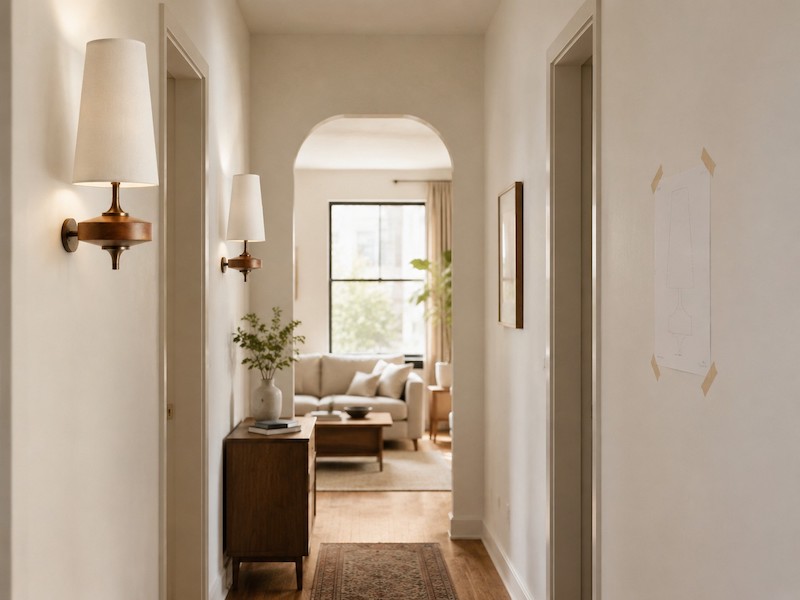
A useful wall sconce placement guide should do more than hand you one height and hope it works. Good placement is a sequence: choose a comfortable vertical band, establish a repeatable center-to-center rhythm, then test whether the fixture itself looks proportionate on the wall. That order keeps a technically neat layout from feeling too high, too crowded or visually weak.
Pass One: Find the Vertical Band Before the Exact Height
Start by viewing the wall from the paths and seats that matter. In a hallway, walk toward the proposed location from both directions. In a living room, check the wall while standing, sitting on the sofa and entering the room. The aim is not to obey a universal number; it is to place the shaded light where it reads comfortably and does not aim an exposed bright source into the eye.
Measure three different points: the center of the light source, the visual center of the complete fixture and the center of the electrical box. Those points may not be identical. A fixture can extend unevenly above and below its mounting point, so treating the junction box as the visual center can shift the finished lamp noticeably.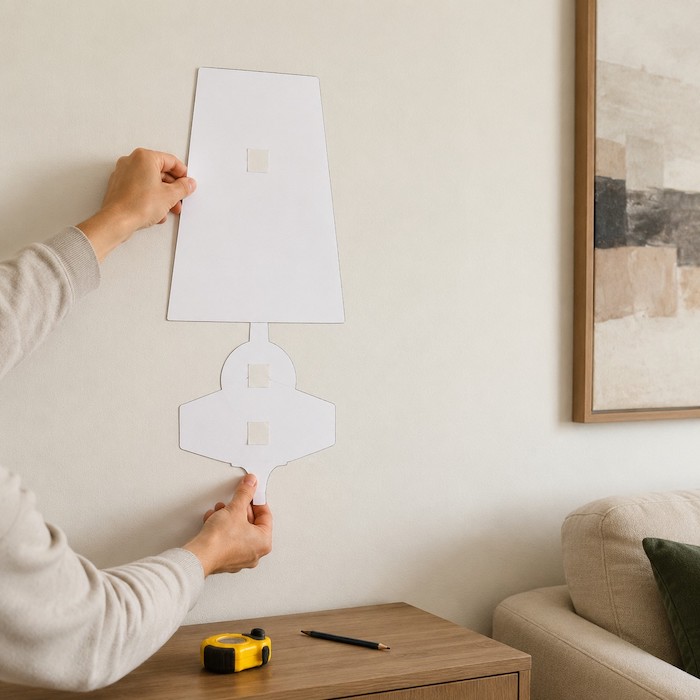
For a detailed room-specific measuring process, keep How High Should Wall Sconces Be? A Room-by-Room Guide beside this overview. It separates hallway and living-room decisions without drifting into bedside or bathroom rules.
Pass Two: Turn a Long Wall into a Measured Rhythm
Spacing begins with the usable run of wall. Exclude door openings, tall built-ins, radiators, switches, artwork that must remain unobstructed and any return wall where a fixture would be visually clipped. Then decide where the first and last fixture centers can sit with calm end margins.
If you are installing several sconces, use this center-spacing formula:
Suppose the first and last centers are 12 ft apart and you want four sconces. The three intervals are 12 / 3, so the centers land 4 ft apart. This is more dependable than dividing the entire hallway length by four, because it preserves the planned margins at both ends.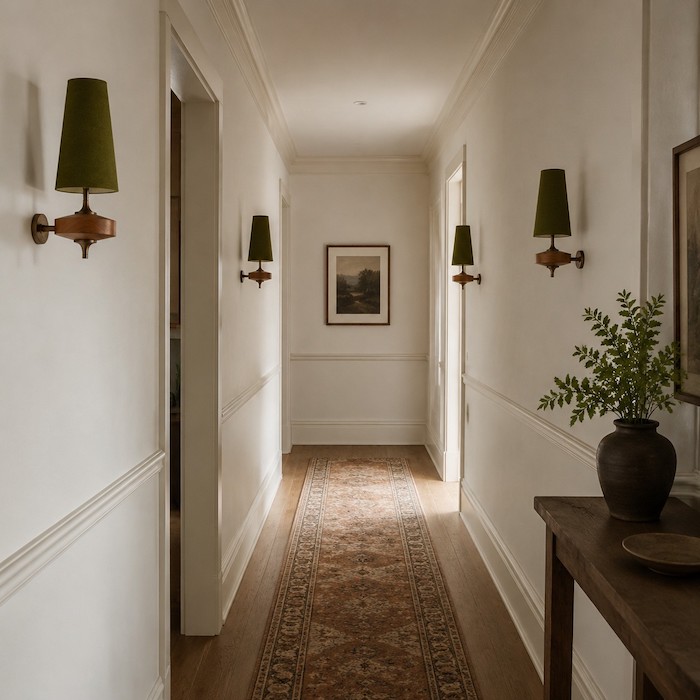
Next, convert center spacing into visible edge gap. Subtract the fixture width from the center spacing. A 48 in center distance with a 7.5 in wide fixture leaves about 40.5 in between fixture edges. A wider 13.8 in fixture leaves about 34.2 in. The electrical rhythm is unchanged, but the wall feels fuller.
The worked examples in How Far Apart Should Wall Sconces Be in a Hallway? show how doors, artwork and end walls change that calculation without destroying the overall sequence.
Pass Three: Check Scale with the Real Fixture Width
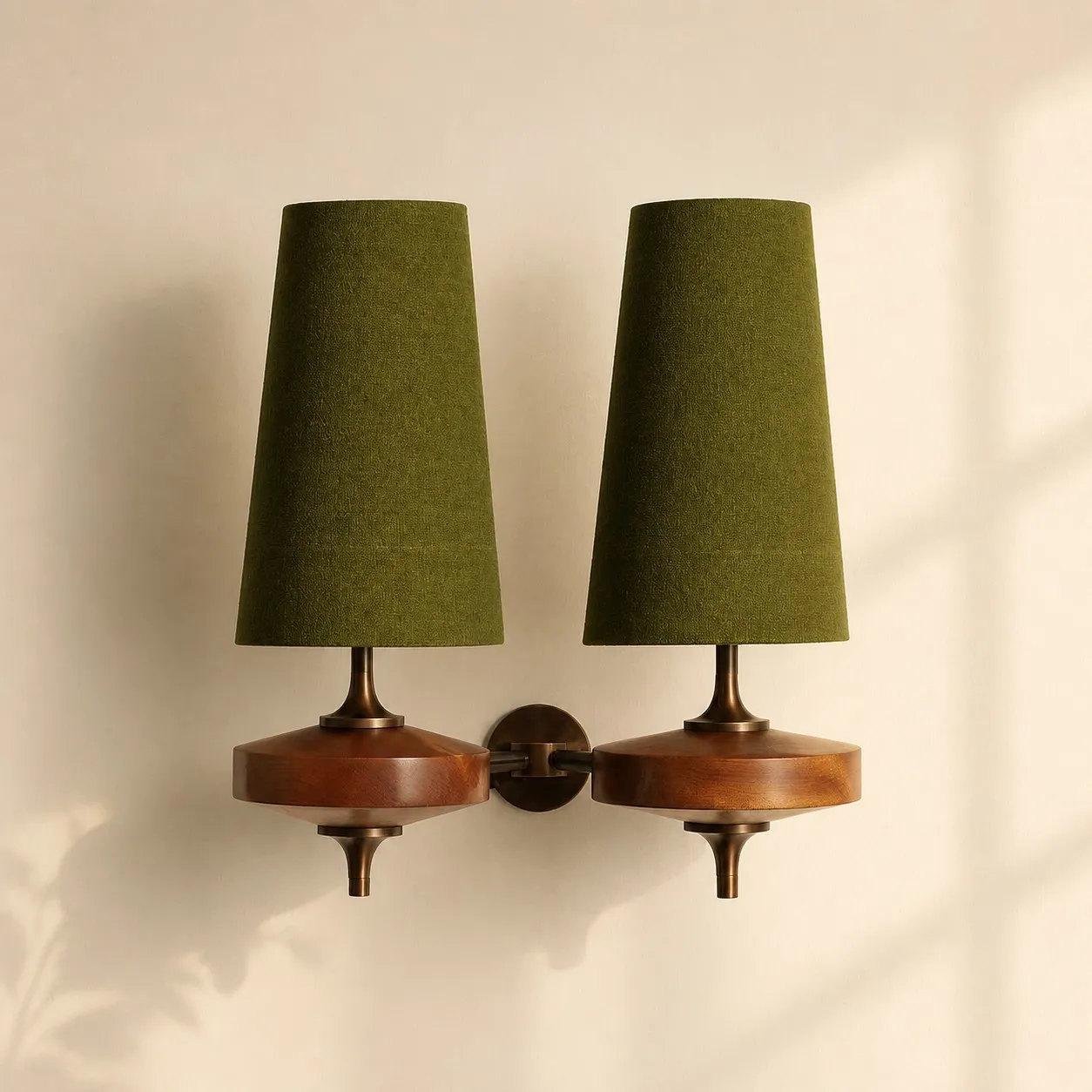
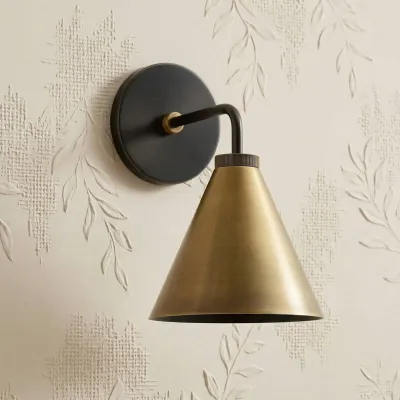
Scale is the step most placement charts omit. A narrow fixture and a wider two-head fixture can share the same mounting height yet feel completely different. According to the current Hour Rho product specification, the one-head version is approximately 19 × 35 cm (7.5 × 13.8 in), while the two-head version is approximately 35 × 35 cm (13.8 × 13.8 in). Use the dimensions of the variant you actually intend to order, and recheck the current page before final electrical work.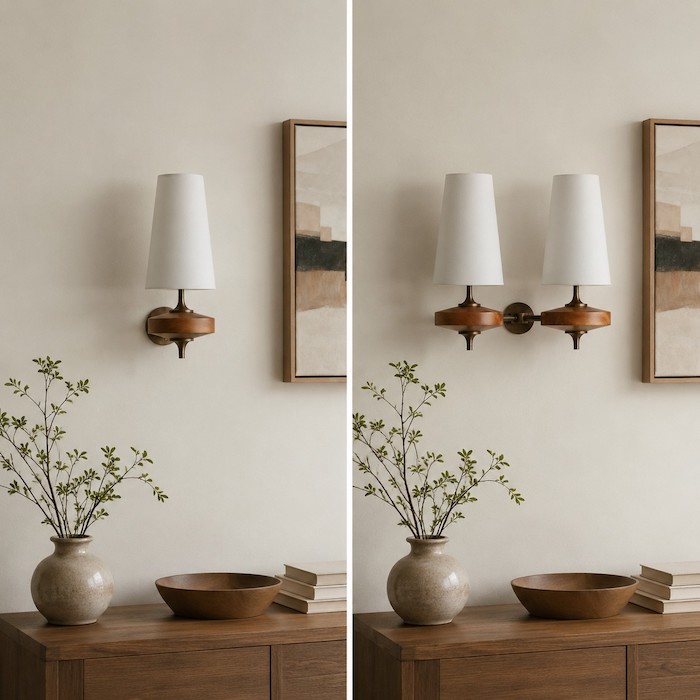
On a short wall pier between a doorway and a corner, the one-head version usually leaves more negative space. On a broad living-room wall, the two-head version can carry more visual weight without multiplying backplates. Neither is automatically better: the wall width and nearby objects decide.
The focused comparison One-Light vs Two-Light Wall Sconces: Which Size Fits? explains that decision as a scale problem, not a belief that more sockets always deliver twice the useful light.
A Room-by-Room Placement Matrix
| Situation | Start with | Then verify | Common adjustment |
|---|---|---|---|
| Long hallway | Usable wall run and equal center intervals | Glare while walking, door swings and projection into the route | Move the first and last centers inward before changing every interval |
| Living-room focal wall | Relationship to art, console or seating group | Appearance from seated and standing viewpoints | Use a wider fixture when the wall feels underfilled |
| Narrow wall pier | Equal clear space on both fixture edges | Shade clearance from trim and the adjacent corner | Choose the one-head scale or relocate the feature |
| Repeated architectural bays | Centers aligned to the bays | Whether every bay is truly equal | Honor architecture rather than forcing one interval across interruptions |
Clearance and Electrical Reality Come Before Symmetry
A beautiful elevation is not useful if the fixture narrows a circulation path or conflicts with construction. The U.S. Access Board's guidance on protruding objects explains why objects that project into circulation routes deserve careful checking. Whether accessibility rules apply depends on the building and local requirements, but the practical habit is broadly useful: verify the fixture's projection and the clear path before committing. The current product page does not state Hour Rho's projection depth, so obtain that measurement rather than guessing from photographs.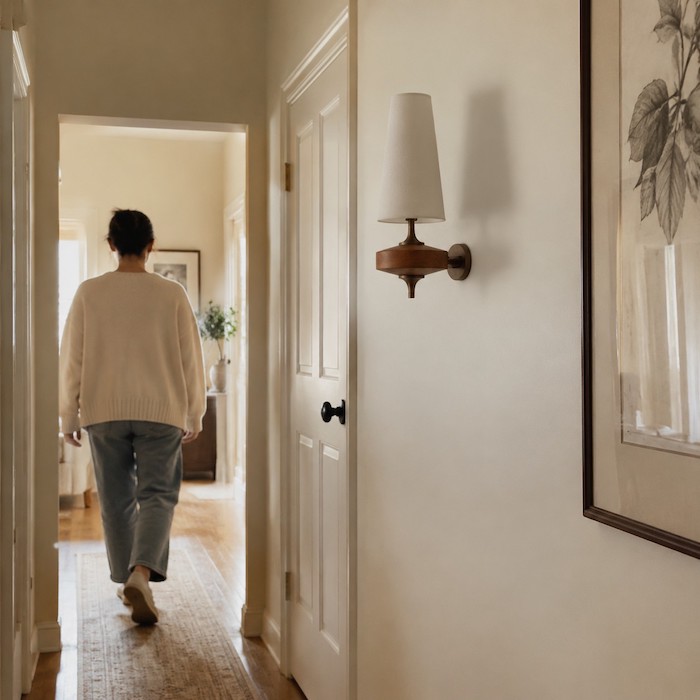
Hour Rho is described as hardwired. A qualified electrician should confirm box position, support, wiring and local-code requirements. The Electrical Safety Foundation International provides guidance on choosing qualified electricians. Plan the composition before the electrician arrives, but let the electrician resolve the electrical work.
Align with Architecture, Not Every Object at Once
Rooms contain competing reference lines: door heads, artwork centers, window trim, shelving and furniture. Trying to align a sconce with all of them creates a compromised position. Choose one dominant datum for each wall. In a repeated hallway, that may be the fixture centerline. Beside a console, it may be the composition of lamp, furniture and art as one group.
When doors interrupt a run, keep the vertical height consistent and let the horizontal intervals flex slightly around openings. A person reads the repeated height first. Minor spacing adjustments are often less noticeable than a sconce crowded against casing.
If a wider wall needs more presence, compare the Hour Rho variants at full scale on paper before selecting the mounting points.
Compare One-Head and Two-Head SizesCommon Placement Mistakes
- Measuring only to the junction-box center. The visible fixture may sit above or below that point.
- Dividing the total room length. Openings and unusable wall segments distort the result.
- Ignoring fixture width. Equal centers do not create equal-looking gaps when variants differ in width.
- Raising sconces just because the ceiling is high. Human sightlines and the nearby composition still matter.
- Assuming the product photograph reveals projection. Ask for the actual depth and check the route.
- Choosing by socket count alone. Shade, lamp lumens, distribution and surrounding surfaces all affect useful brightness.
Your Five-Minute Final Check
- Mark the light-source center, fixture center and box center separately.
- Tape the actual outside dimensions of the selected variant on the wall.
- Walk the hallway and sit in the living room to test sightlines.
- Calculate center spacing, then calculate the remaining edge gap.
- Check doors, art, trim, switches, projection and the clear path.
- Photograph the taped layout and approve it with the electrician before work begins.
This process replaces a fragile “standard height” with evidence from the room itself. The result should look composed from the main viewpoints, maintain breathing room around the fixture and remain practical to wire and use.
Frequently Asked Questions
Should every sconce in a hallway be exactly the same distance apart?
Equal centers create calm rhythm, but doorways and wall breaks can justify small adjustments. Keep height consistent and avoid crowding trim.
Does a taller ceiling mean the sconces should be higher?
Not automatically. Check human sightlines, the fixture's shade and nearby furniture before responding to ceiling height.
What should I measure before ordering?
Record usable wall width, desired center positions, fixture width and height, projection, box location and clearances around doors and art.
Can I place a two-head sconce at the same height as a one-head version?
Possibly, if their overall height and light-source positions work in the room. Tape both outlines and compare their visual centers.
Should wall sconces line up with artwork?
Only when the art and sconces form one deliberate composition. Otherwise, align to the wall's architecture or a repeated fixture centerline.